
Our mission is to support women and children by promoting an efficient, accessible family court system that provides fair, safe, and uniform justice.
What we do
Through advocacy, collaboration, and education, we provide workable solutions to strengthen the family court system for all.
MFAC Advocacy News
Ongoing
MFAC continues to educate the public about the devastating impact of abusive litigation on families, children, and court users across the Commonwealth. S.1205, An Act Relative to Controlling and Abusive Litigation, remains alive in the Massachusetts Senate — but time is running out to pass this critical legislation before the end of the current legislative session. Why pass it:
- The majority of Massachusetts’ Senators have signed on as primary sponsors for S.1205.
- The Massachusetts Caucus of Women Legislators formally endorsed S.1205, recognizing its direct alignment with the Caucus’s strategic priorities.
- Jane Doe Inc., the statewide coalition representing 60+ domestic abuse agencies has named S.1205 a priority bill and is committed to advancing its passage.
- Research data from Brandeis University supports the need for S.1205 to address the documented harm that abusive litigation inflicts on survivors, families, and taxpayer-funded public welfare programs.
- Thousands of abusive litigation survivors across Massachusetts, whose families, resources, and lives have been and continue to be disrupted by ongoing abusive litigation, are urging for the passage of S.1205.
Time doesn’t stand still in Family Court for children. Contact your legislator TODAY to encourage passage of S. 1205.
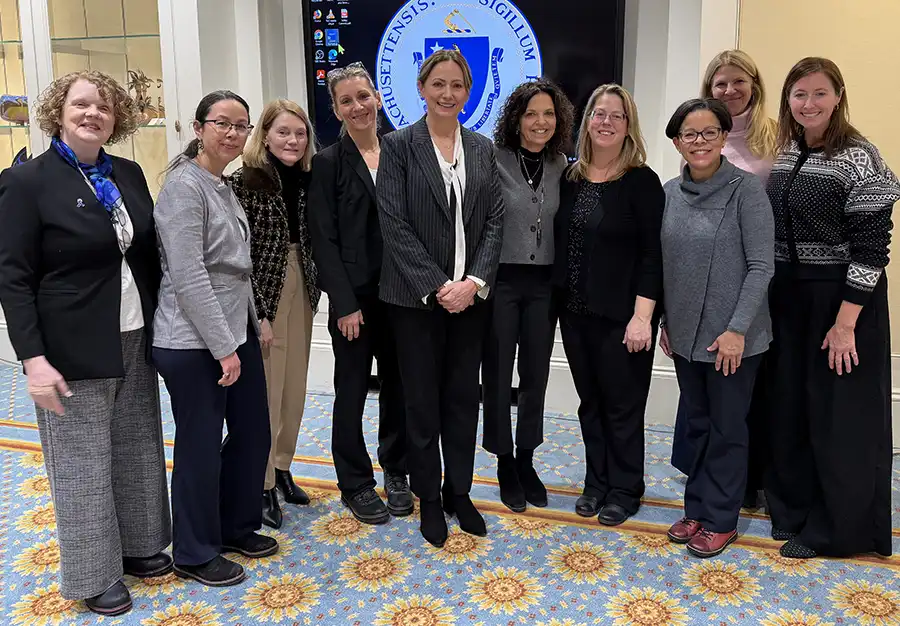
MFAC members and Executive Director Margie Palladino together with TRAC (Together Rising Above Coalition) members Jamie Sabino (MLRI) and Hema Sarang-Sieminski (Executive Director of Jane Doe) gather at the State House holding a legislative briefing on the critical need to pass S.1205, An Act Relative to Controlling and Abusive Litigation, to protect families and children in Massachusetts.
May 2026
MFAC presents its second Family Law Symposium, Unequal Aftermath: Economic Vulnerability During and Post Divorce, at Suffolk University Law School. Co-sponsored by MLRI, Women’s Bar Foundation, Women’s Bar Association, and Social Library, panels of lawyers, advocates, and financial experts spoke on a variety of topics impacting the financial stability of divorced spouses and families. Obtain handouts here.
July 2025
Several MFAC advocates met with Massachusetts State Senator Lydia Edwards, chair of the Massachusetts Senate Judiciary Committee, to share their lived experience with abusive litigation in Massachusetts Probate and Family Court. Many women in domestic abuse situations have found that abuse doesn’t end when they leave the relationship—it simply moves from the home into the courtroom. Many abusers manipulate the courtroom process to maintain power over the survivor, drain finances, and inflict further trauma. The Senate is considering passage of S. 1205, An Act Relative to Controlling and Abusive Litigation to strengthen the Court’s ability to end this abuse.
December 2024
MFAC submitted its RECOMMENDATIONS TO THE 2024-2025 MASSACHUSETTS CHILD SUPPORT GUIDELINES TASK FORCE including detailed explanations on how the proposed updates would serve the best interest of the Commonwealth’s children and improve the family law process for all.
November 2024
MFAC submitted this amicus brief to the Massachusetts Appeals Court in the second appeal of the seminal case, Cavanagh v. Cavanagh. MFAC explains in the brief why an alimony order is warranted.
The Appeals Court published its decision in this case in July 2025. The Court reaffirmed the groundbreaking principle in the first Cavanagh case that judges must run both sets of calculations — alimony-first and child-support-first — and then compare them. The Cavanagh rulings mean that support awards can be potentially larger than before because the court reinforced that alimony serves a different purpose than child support and that the trial court must consider the marital standard of living. In longer term marriages, both spouses should, absent unusual circumstances, maintain comparable lifestyles.
September 2024
This month Massachusetts Coercive Control legislation becomes law. The statutory definition of “domestic abuse” is now expanded to include applicable non-physical abusive behavior used to dominate an intimate partner.
Read this helpful Coercive Control Fact Sheet prepared by MFAC in collaboration with MLRI (Massachusetts Legal Reform Institute) and HAWC (Healing Abuse Working for Change). The Fact Sheet is helpful to attorneys, police, advocates, and survivors in understanding application of the new law.

SPOUSAL SUPPORT UPDATE
Read MFAC’s amicus brief submitted to the Supreme Judicial Court of Massachusetts supporting savings as a need for alimony recipients and explaining why alimony should be calculated on the parties’ income, not expenses.
MFAC WORKING REPORT
Read MFAC’s Equitable & Accessible Justice for All – A Working Report on the Massachusetts Family Court System. The Report details issues experienced by our members and makes recommendations for change.
Where to Find Domestic Violence Services or Legal Help
WHO WE ARE
OUR FOUNDING MEMBERS:
Forged by their own experiences with the Massachusetts family court system, MFAC was founded by a grassroots group of women who seek a fair, safe, and streamlined family court system for all and that ensures the best interests of children.
Our collective experiences have shown that the family court system is under-resourced and at risk for misuse and inequities, the judicial outcomes are unpredictable, and the expense and delay are unconstrained.
These systemic shortfalls are barriers to accessible and equitable justice for families.
With the legendary phoenix as our emblem, we believe that each challenge brings an opportunity for change and renewal and a better family court system for all.
MFAC was formed by members and leaders of the Awareness and Advocacy Committee at Jane Does Well, an organization that was created to support women undergoing the challenges of divorce.